Introduction
The modern digital computer was invented and intended as a device that should facilitate and speed up complicated and time-consuming computations. In the majority of applications its capability to store and access large amounts of information plays the dominant part and is considered to be its primary characteristic, and its ability to compute, i.e., to calculate, to perform arithmetic, has in many cases become almost irrelevant.
In all these cases, the large amount of information that is to be processed in some sense represents an abstraction of a part of the real world. The information that is available to the computer consists of a selected set of data about the real world, namely, that set which is considered relevant to the problem at hand, that set from which it is believed that the desired results can be derived. The data represent an abstraction of reality in the sense that certain properties and characteristics of the real objects are ignored because they are peripheral and irrelevant to the particular problem. An abstraction is thereby also a simplification of facts.
We may regard a personnel file of an employer as an example. Every employee is represented (abstracted) on this file by a set of data relevant either to the employer or to his accounting procedures. This set may include some identification of the employee, for example, his name and his salary. But it will most probably not include irrelevant data such as the color of hair, weight, and height.
In solving a problem with or without a computer it is necessary to choose an abstraction of reality, i.e., to define a set of data that is to represent the real situation. This choice must be guided by the problem to be solved. Then follows a choice of representation of this information. This choice is2 guided by the tool that is to solve the problem, i.e., by the facilities offered by the computer. In most cases these two steps are not entirely independent.
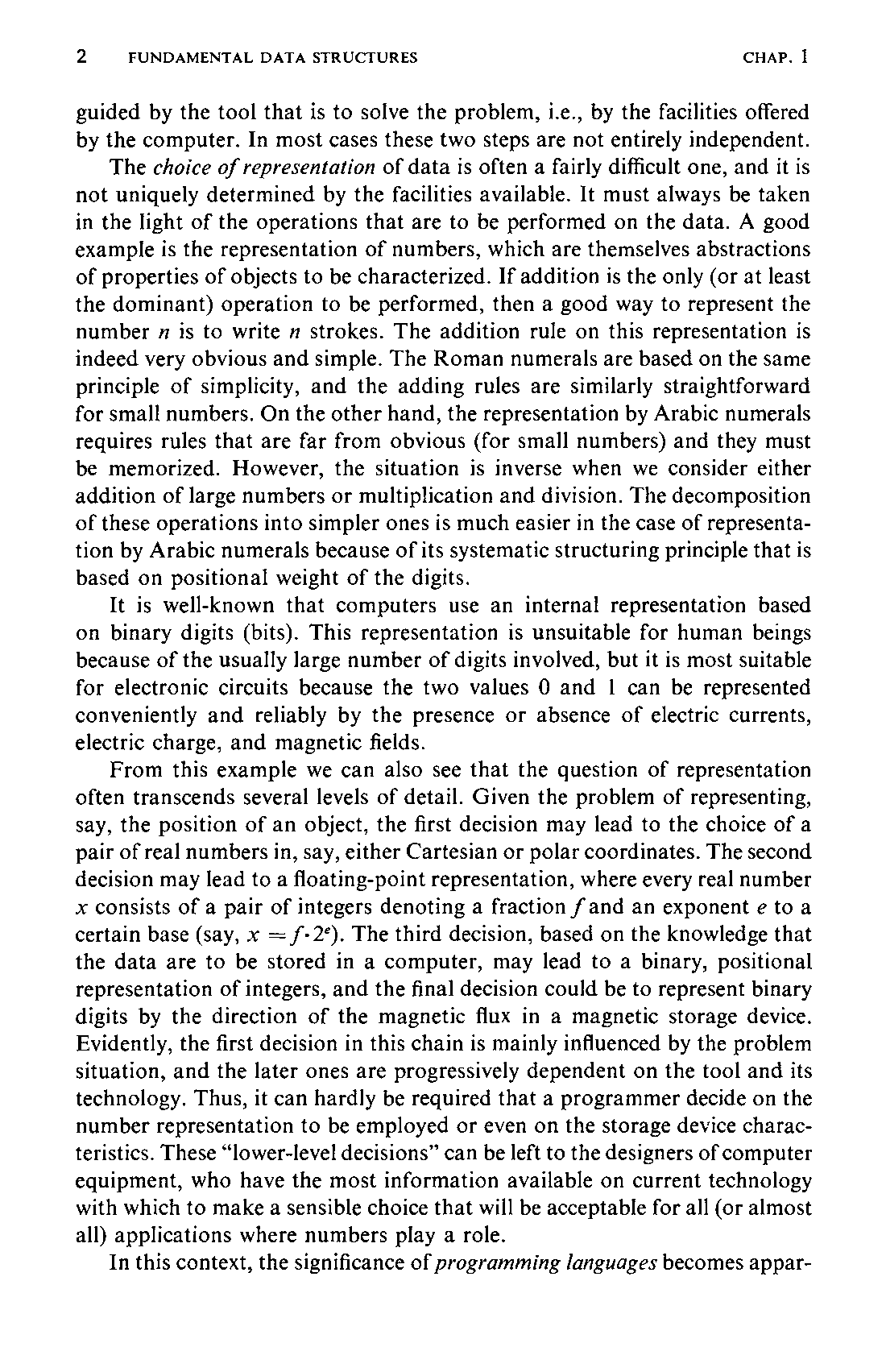
The choice of representation of data is often a fairly difficult one, and it is not uniquely determined by the facilities available. It must always be taken in the light of the operations that are to be performed on the data. A good example is the representation of numbers, which are themselves abstractions of properties of objects to be characterized. If addition is the only (or at least the dominant) operation to be performed, then a good way to represent the number is to write strokes. The addition rule on this representation is indeed very obvious and simple. The Roman numerals are based on the same principle of simplicity, and the adding rules are similarly straightforward for small numbers. On the other hand, the representation by Arabic numerals requires rules that are far from obvious (for small numbers) and they must be memorized. However, the situation is inverse when we consider either addition of large numbers or multiplication and division. The decomposition of these operations into simpler ones is much easier in the case of representation by Arabic numerals because of its systematic structuring principle that is based on positional weight of the digits.
It is well-known that computers use an internal representation based on binary digits (bits). This representation is unsuitable for human beings because of the usually large number of digits involved, but it is most suitable for electronic circuits because the two values 0 and 1 can be represented conveniently and reliably by the presence or absence of electric currents, electric charge, and magnetic fields.
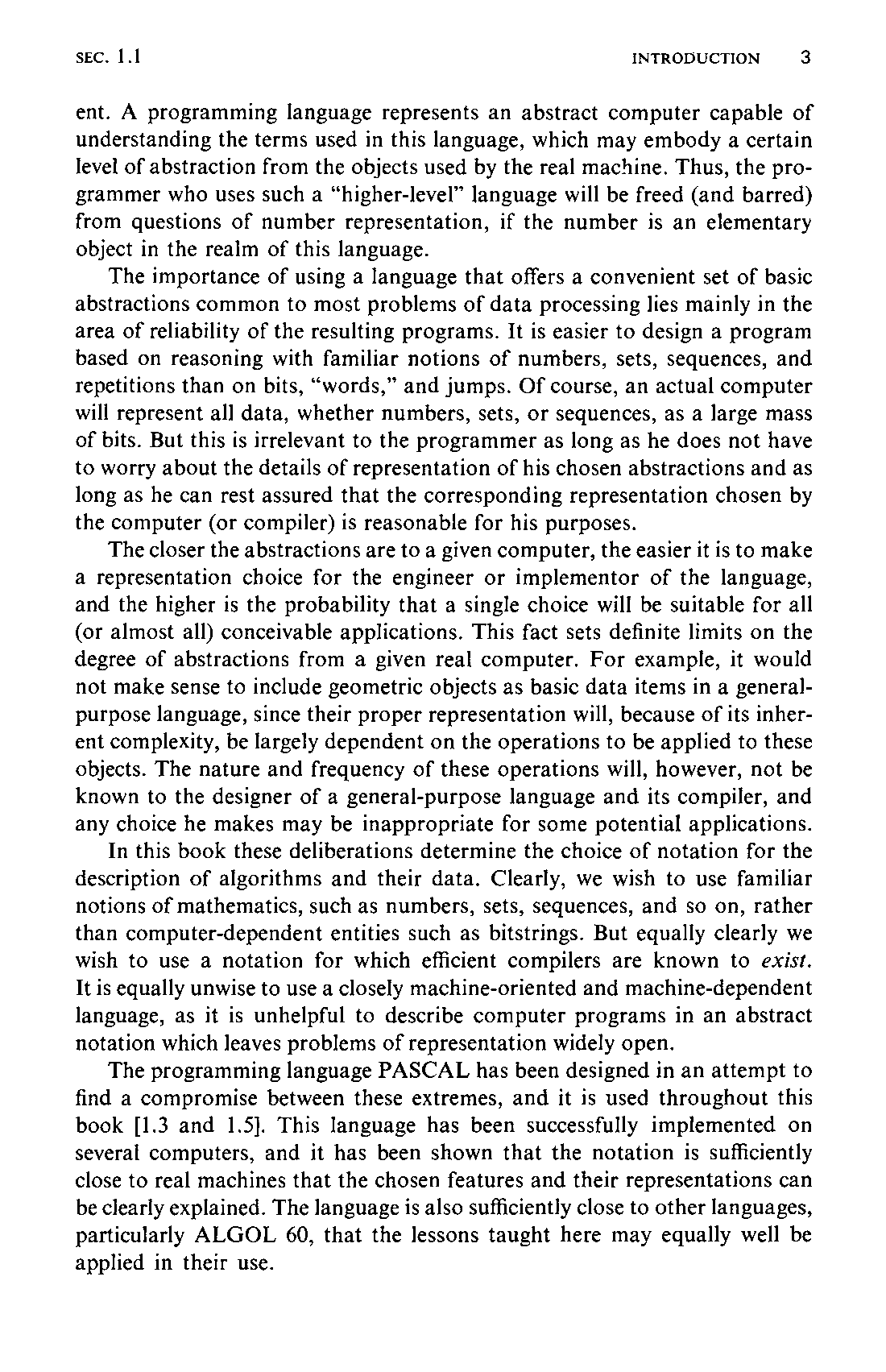
From this example we can also see that the question of representation often transcends several levels of detail. Given the problem of representing, say, the position of an object, the first decision may lead to the choice of a pair of real numbers in, say, either Cartesian or polar coordinates. The second decision may lead to a floating-point representation, where every real number consists of a pair of integers denoting a fraction and an exponent to a certain base (say, ). The third decision, based on the knowledge that the data are to be stored in a computer, may lead to a binary, positional representation of integers, and the final decision could be to represent binary digits by the direction of the magnetic flux in a magnetic storage device. Evidently, the first decision in this chain is mainly influenced by the problem situation, and the later ones are progressively dependent on the tool and its technology. Thus, it can hardly be required that a programmer decide on the number representation to be employed or even on the storage device characteristics. These “lower-level decisions” can be left to the designers of computer equipment, who have the most information available on current technology with which to make a sensible choice that will be acceptable for all (or almost all) applications where numbers play a role.
In this context, the significance of programming languages becomes apparent.3 A programming language represents an abstract computer capable of understanding the terms used in this language, which may embody a certain level of abstraction from the objects used by the real machine. Thus, the programmer who uses such a “higher-level” language will be freed (and barred) from questions of number representation, if the number is an elementary object in the realm of this language.
The importance of using a language that offers a convenient set of basic abstractions common to most problems of data processing lies mainly in the area of reliability of the resulting programs. It is easier to design a program based on reasoning with familiar notions of numbers, sets, sequences, and repetitions than on bits, “words,” and jumps. Of course, an actual computer will represent all data, whether numbers, sets, or sequences, as a large mass of bits. But this is irrelevant to the programmer as long as he does not have to worry about the details of representation of his chosen abstractions and as long as he can rest assured that the corresponding representation chosen by the computer (or compiler) is reasonable for his purposes.
The closer the abstractions are to a given computer, the easier it is to make a representation choice for the engineer or implementor of the language, and the higher is the probability that a single choice will be suitable for all (or almost all) conceivable applications. This fact sets definite limits on the degree of abstractions from a given real computer. For example, it would not make sense to include geometric objects as basic data items in a general-purpose language, since their proper representation will, because of its inherent complexity, be largely dependent on the operations to be applied to these objects. The nature and frequency of these operations will, however, not be known to the designer of a general-purpose language and its compiler, and any choice he makes may be inappropriate for some potential applications.
In this book these deliberations determine the choice of notation for the description of algorithms and their data. Clearly, we wish to use familiar notions of mathematics, such as numbers, sets, sequences, and so on, rather than computer-dependent entities such as bitstrings. But equally clearly we wish to use a notation for which efficient compilers are known to exist. It is equally unwise to use a closely machine-oriented and machine-dependent language, as it is unhelpful to describe computer programs in an abstract notation which leaves problems of representation widely open.
The programming language PASCAL has been designed in an attempt to find a compromise between these extremes, and it is used throughout this book [1.3 and 1.5]. This language has been successfully implemented on several computers, and it has been shown that the notation is sufficiently close to real machines that the chosen features and their representations can be clearly explained. The language is also sufficiently close to other languages, particularly ALGOL 60, that the lessons taught here may equally well be applied in their use.