A Translator from BNF into Parser-Driving Data Structures
A translator accepting BNF-productions, converting them into some other representation, is a genuine example of a program whose input data can be regarded as sentences belonging to a language. In fact, it is most appropriate to consider BNF as a language itself, characterized by its own syntax that may, of course, once again be specified in terms of BNF-productions. As a consequence, this translator may serve as a further example of the construction of a recognizer that is, moreover, extended into a translator, or, in general, a processor of its input. Therefore, we shall proceed in the following manner:
Step I. Define a syntax of the meta language, called EBNF (for Extended BNF).
Step 2. Construct a recognizer for EBNF according to the rules given in Sect. 5.4.
Step 3. Extend the recognizer into a translator, combining it with the table-driven parser.
Let the meta-language—the language of syntax productions—be described by the following productions:
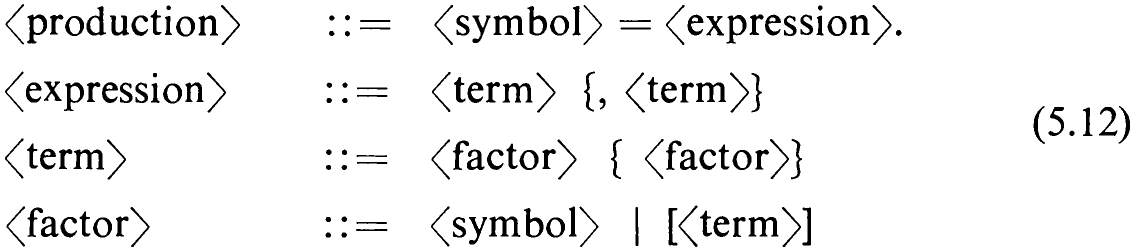
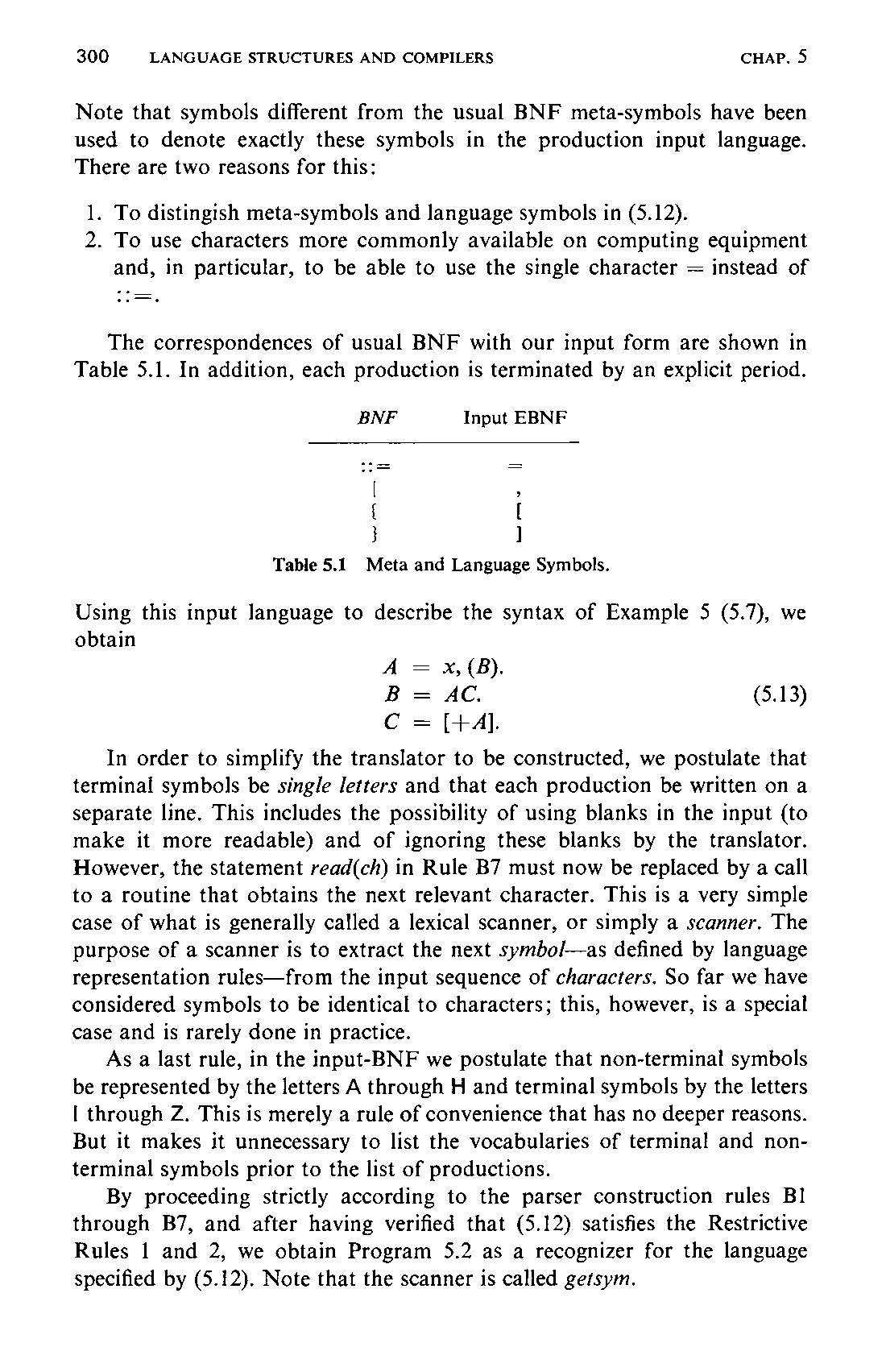
Note that symbols different from the usual BNF meta-symbols have been used to denote exactly these symbols in the production input language. There are two reasons for this:
-
To distingish meta-symbols and language symbols in (5.12).
-
To use characters more commonly available on computing equipment and, in particular, to be able to use the single character = instead of

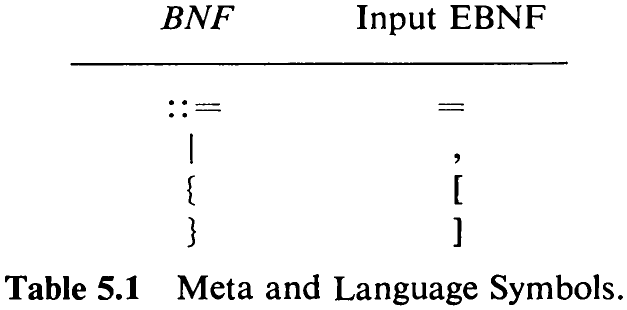
The correspondences of usual BNF with our input form are shown in Table 5.1. In addition, each production is terminated by an explicit period.
Using this input language to describe the syntax of Example 5 (5.7), we obtain

In order to simplify the translator to be constructed, we postulate that terminal symbols be single letters and that each production be written on a separate line. This includes the possibility of using blanks in the input (to make it more readable) and of ignoring these blanks by the translator. However, the statement read(ch) in Rule B7 must now be replaced by a call to a routine that obtains the next relevant character. This is a very simple case of what is generally called a lexical scanner, or simply a scanner. The purpose of a scanner is to extract the next symbol—as defined by language representation rules—from the input sequence of characters. So far we have considered symbols to be identical to characters; this, however, is a special case and is rarely done in practice.
As a last rule, in the input-BNF we postulate that non-terminal symbols be represented by the letters A through H and terminal symbols by the letters | through Z. This is merely a rule of convenience that has no deeper reasons. But it makes it unnecessary to list the vocabularies of terminal and non-terminal symbols prior to the list of productions.
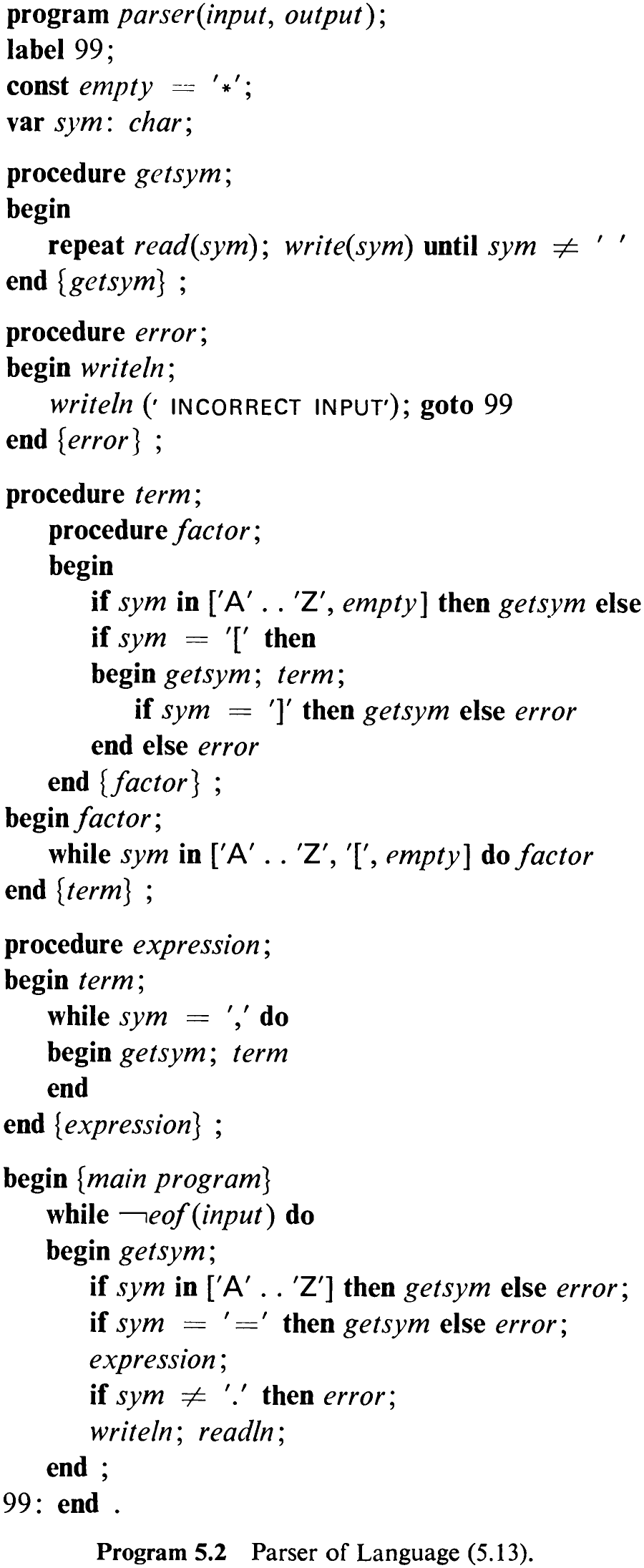
By proceeding strictly according to the parser construction rules Bl through B7, and after having verified that (5.12) satisfies the Restrictive Rules 1 and 2, we obtain Program 5.2 as a recognizer for the language specified by (5.12). Note that the scanner is called getsym.
301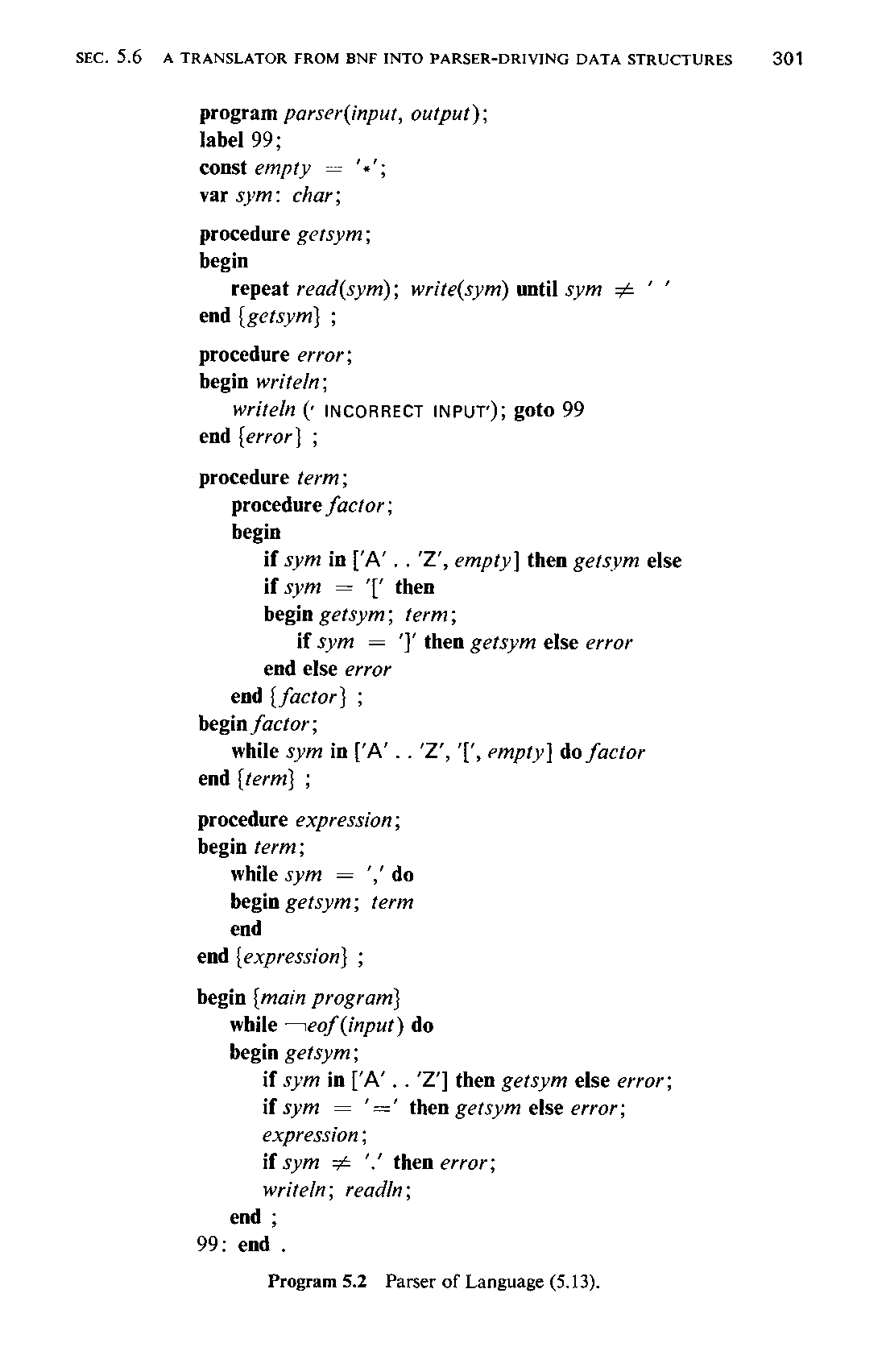
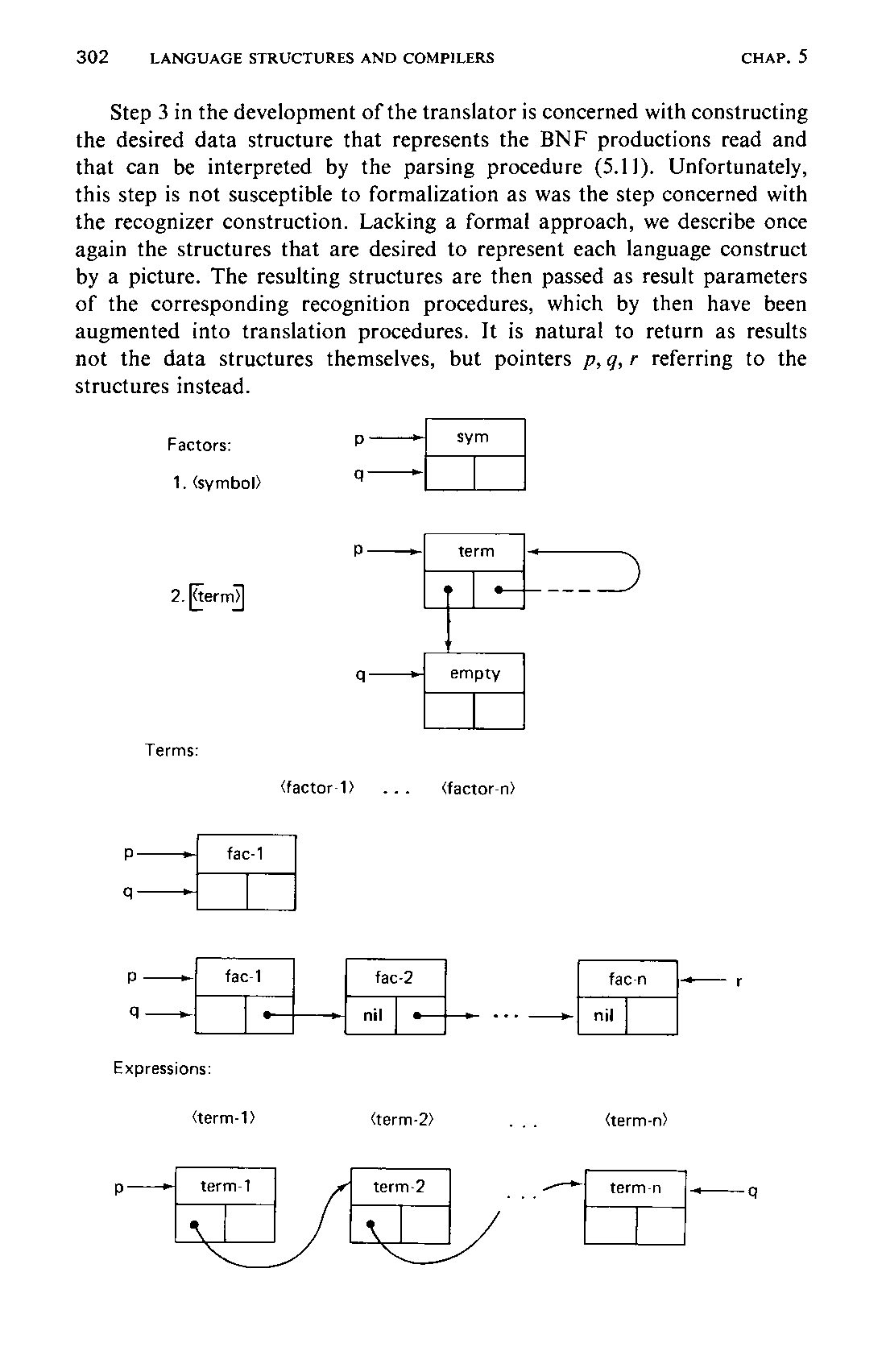
Step 3 in the development of the translator is concerned with constructing the desired data structure that represents the BNF productions read and that can be interpreted by the parsing procedure (5.11). Unfortunately, this step is not susceptible to formalization as was the step concerned with the recognizer construction. Lacking a formal approach, we describe once again the structures that are desired to represent each language construct by a picture. The resulting structures are then passed as result parameters of the corresponding recognition procedures, which by then have been augmented into translation procedures. It is natural to return as results not the data structures themselves, but pointers p,g,r referring to the structures instead.
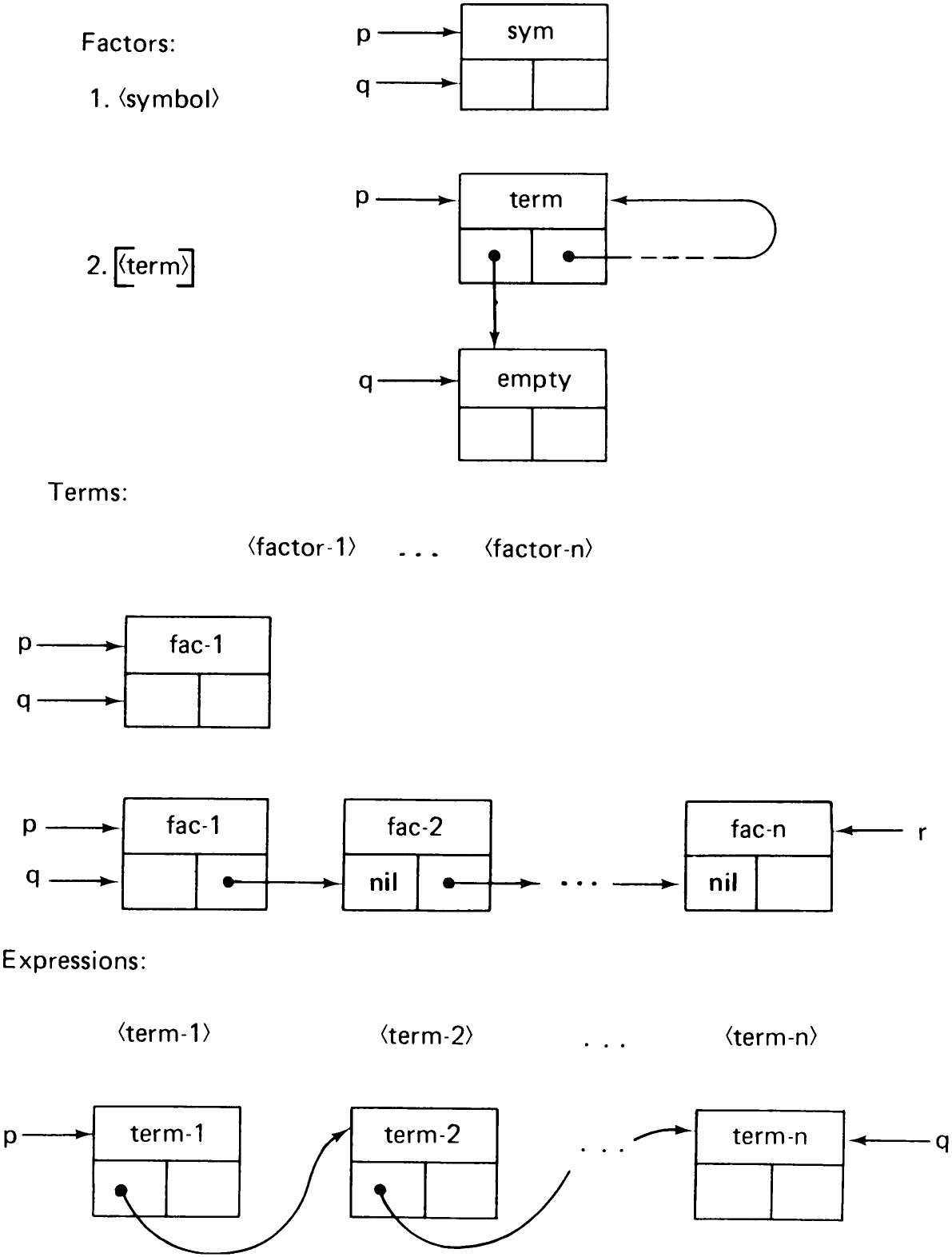
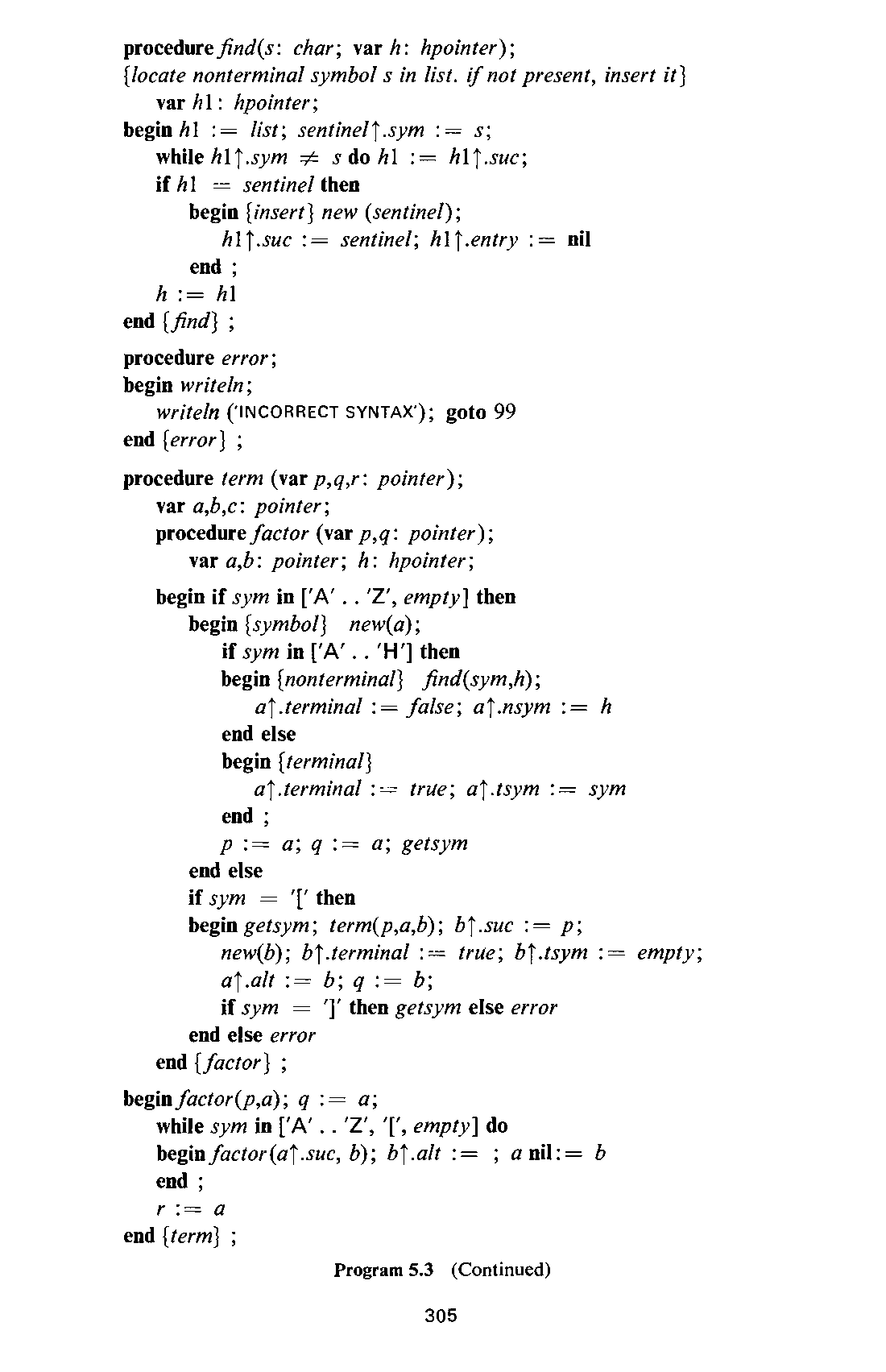
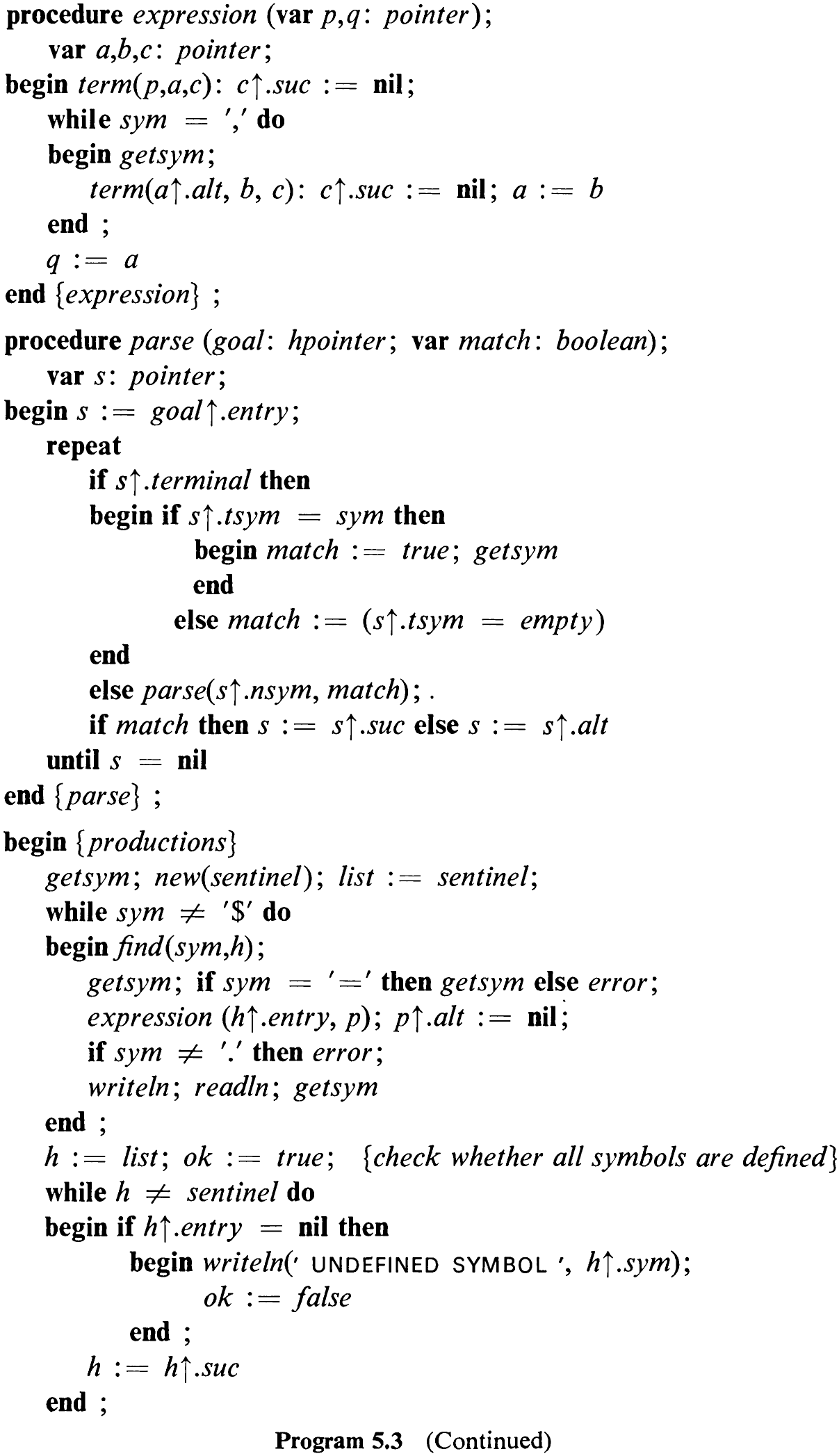
Clearly, it is the task of the procedure factor to generate new elements of the data structure; the task of the remaining two procedures is to link them together into a linear list in which term uses the suc field and expression uses the alt field for chaining. The details are evident from Program 5.3.
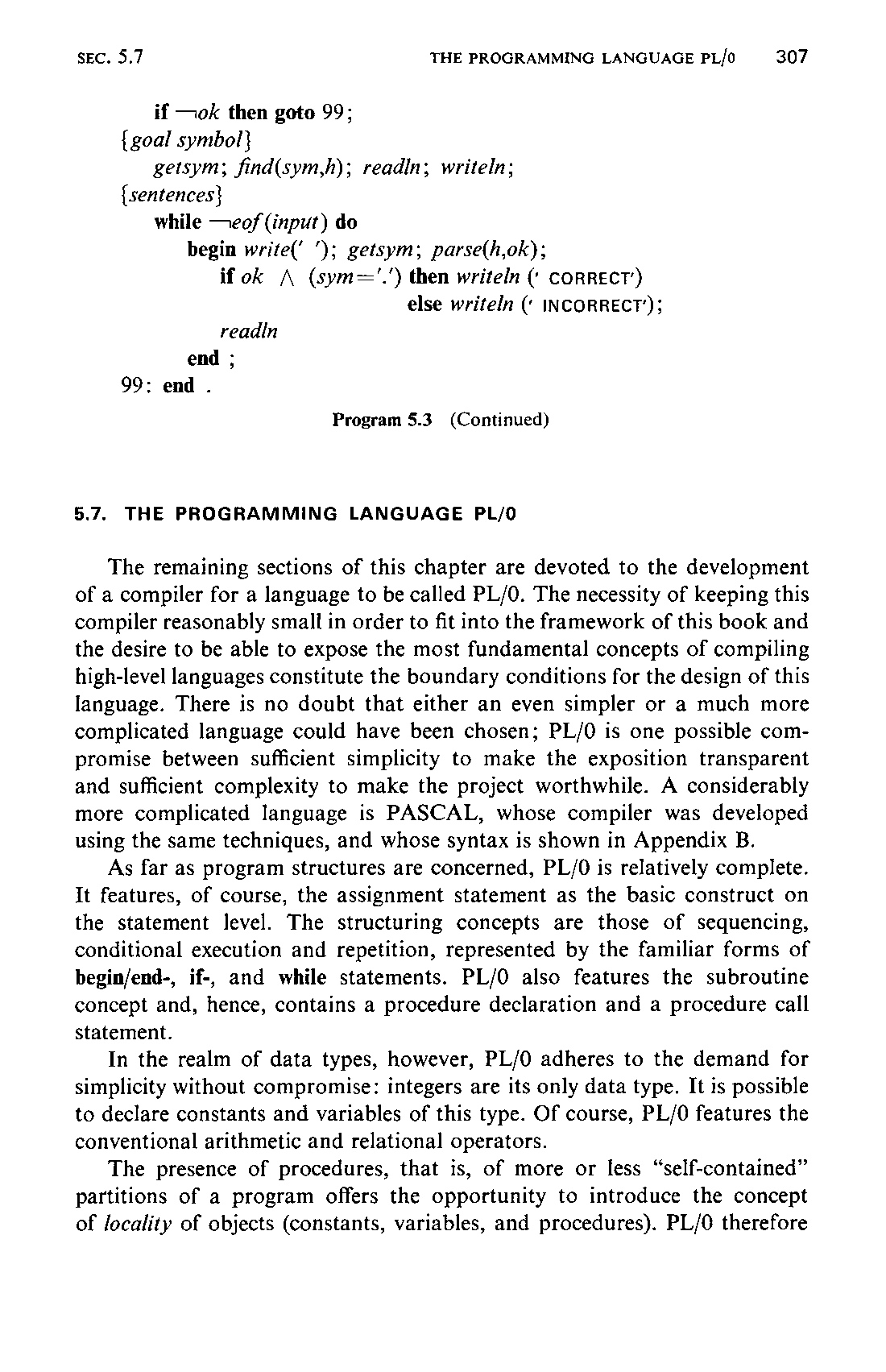
The technique of processing non-terminal symbols needs further clarification. It is possible for a non-terminal symbol to appear as a factor before it appears as a left part in a production. A procedure find(sym, h) is used to locate the symbol sym in a linear list in which all headers representing the non-terminal symbols are collected. If a symbol is located, its reference is assigned to A; if it is not yet present in the list, it is added to the list. Procedure find uses the sentinel technique discussed in detail in Chap. 4.
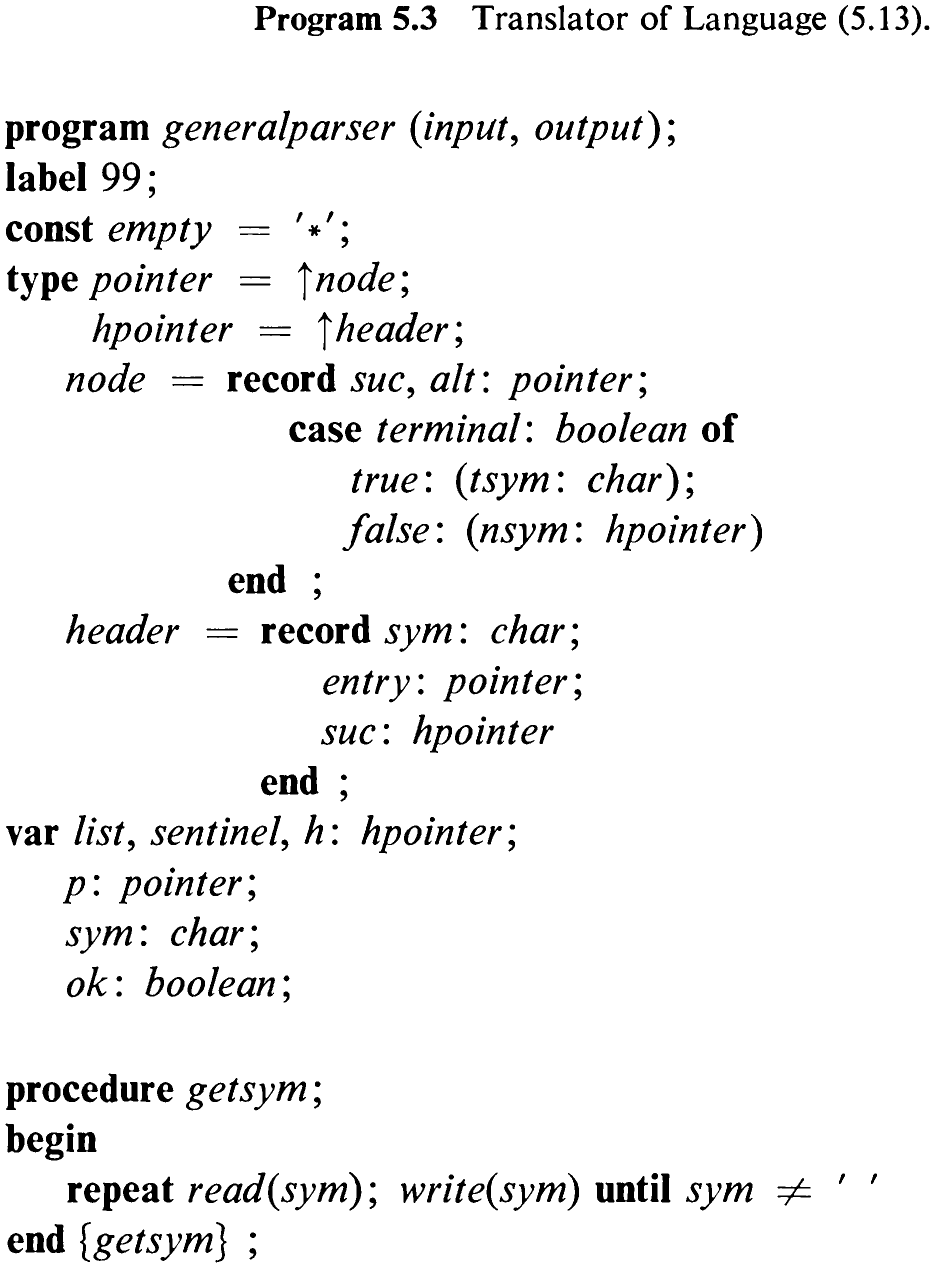
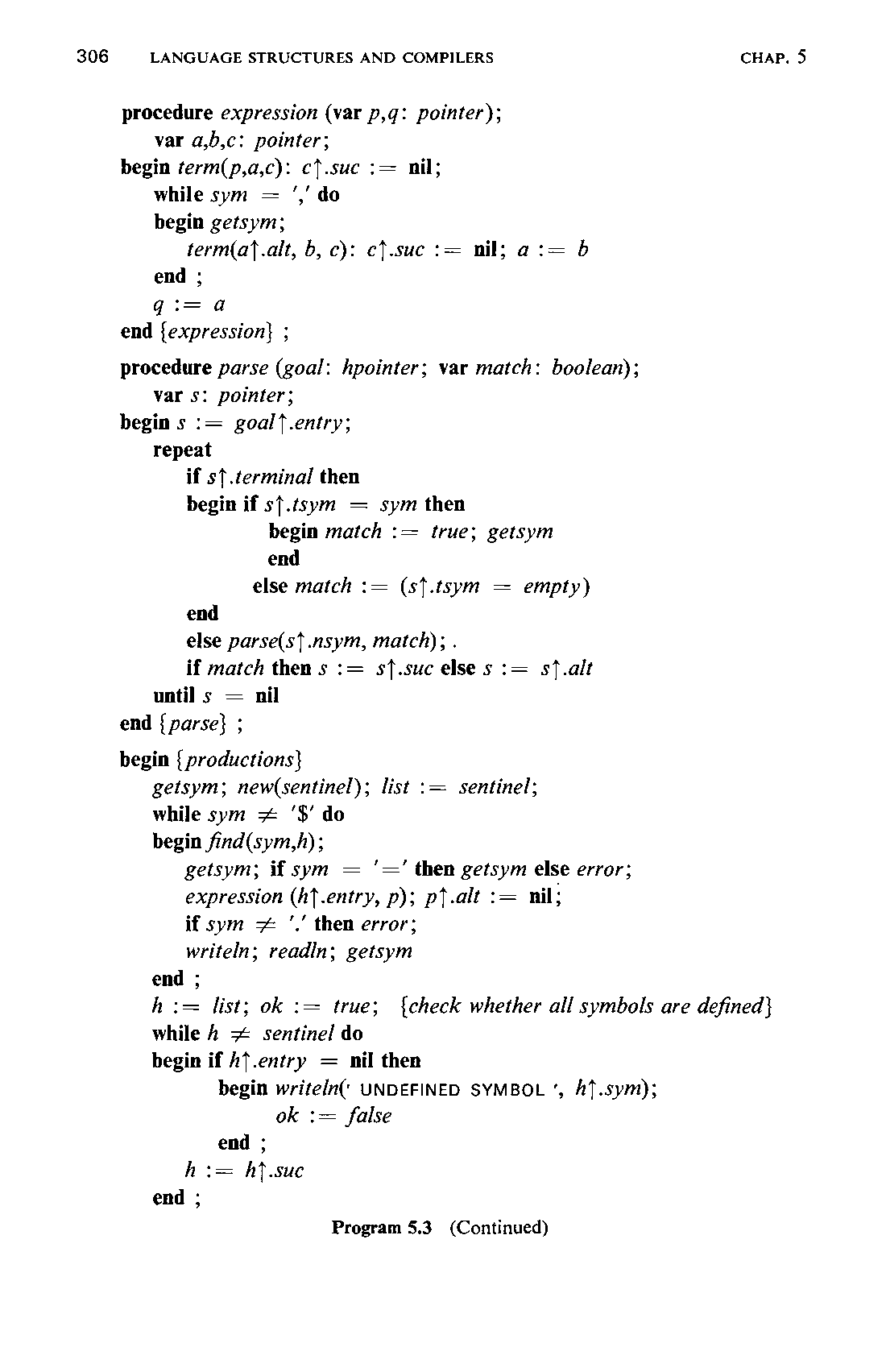
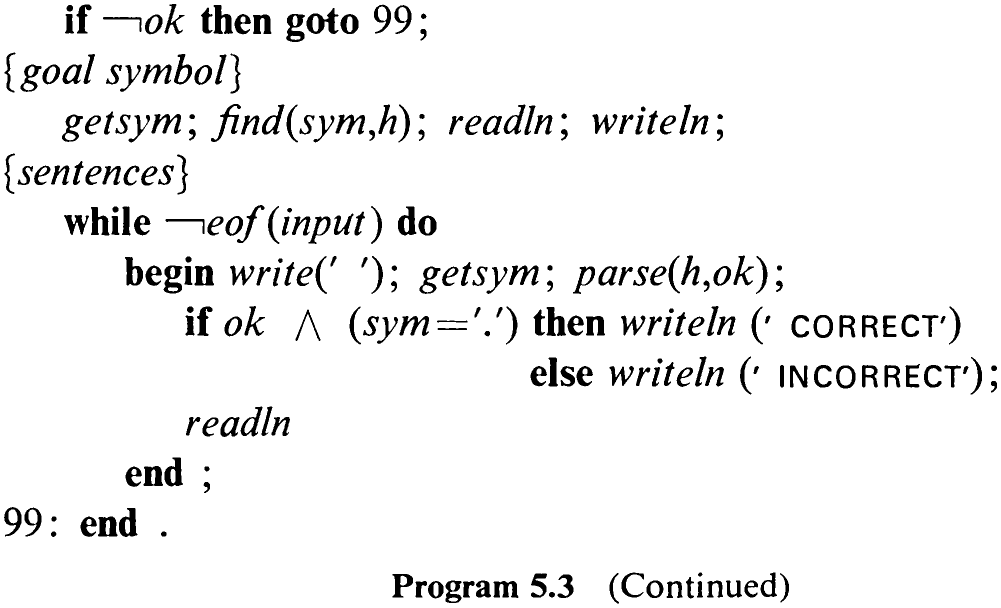
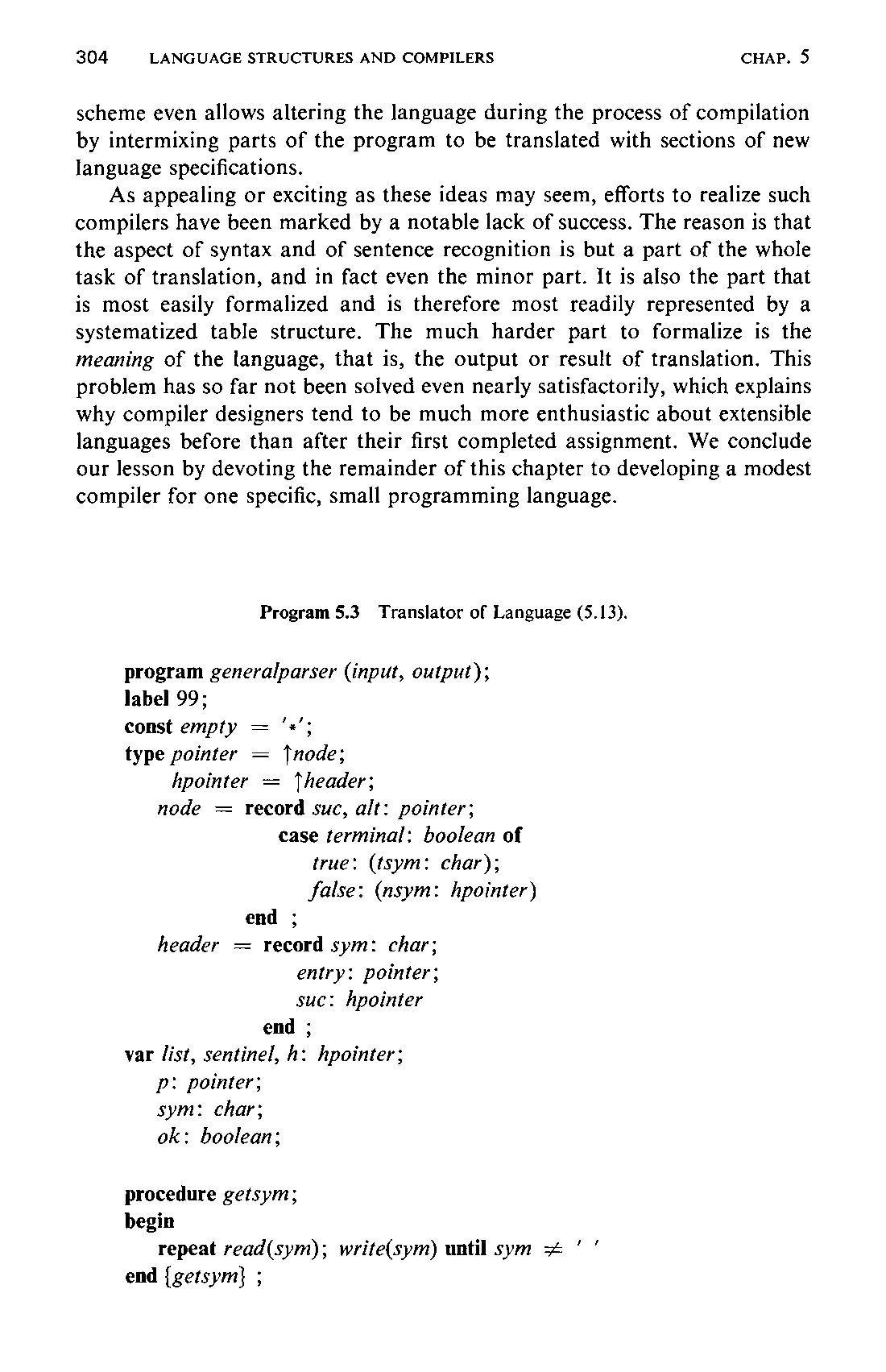
Program 5.3 consists of three parts, each corresponding to a section of input. Part | is concerned with the processing of productions into corresponding data structures. Part 2 reads and identifies a single symbol, namely, the one specified as the start symbol which generates sentences of the language. (It is preceded by a $ sign delimiting Parts 1 and 2 of the input data.) Part 3 is the parsing program (5.11) reading input sentences under control of the data structure generated in Part |.
It is noteworthy that Program 5.3 has been developed by merely inserting further statements into the unchanged Program 5.2. The existing program deals exclusively with the recognition of correctly formed sentences, and it can be used as a framework for the extended program that not only recognizes but also processes or translates the accepted sentences. This method. of constructing language processors by stepwise refinement, or rather stepwise enrichment, is highly recommended. It permits the designer to deal exclusively with a selected aspect of language processing before taking into account other aspects, and hence it facilitates the task of verifying the correctness of a translator program, or at least of maintaining a high confidence level throughout the program’s development. In this rather simple example this development consists of only two steps. More complicated languages and more complicated translation tasks require a considerably higher number of individual enrichment steps. A highly similar development in three steps will be the subject of Sects. 5.8 through 5.11.
As evidenced by the development of Program 5.3, the syntax table-driven —or rather data structure-driven—approach to parsing provides a degree of freedom and flexibility not presented in the scheme of the specific parser program. This additional flexibility, although not required in general, is the very essence of compilers for so-called extensible languages. An extensible language can be extended by further syntactic constructs, more or less at the discretion of the programmer. Analogous to the input of Program 5.3, the input of an extensible language compiler consists of a section specifying the language extensions used in the subsequent program. A more ambitious304 scheme even allows altering the language during the process of compilation by intermixing parts of the program to be translated with sections of new language specifications.
As appealing or exciting as these ideas may seem, efforts to realize such compilers have been marked by a notable lack of success. The reason is that the aspect of syntax and of sentence recognition is but a part of the whole task of translation, and in fact even the minor part. It is also the part that is most easily formalized and is therefore most readily represented by a systematized table structure. The much harder part to formalize is the meaning of the language, that is, the output or result of translation. This problem has so far not been solved even nearly satisfactorily, which explains why compiler designers tend to be much more enthusiastic about extensible languages before than after their first completed assignment. We conclude our lesson by devoting the remainder of this chapter to developing a modest compiler for one specific, small programming language.