Introduction
The primary purpose of this chapter is to provide an extensive set of examples illustrating the use of the data structures introduced in the preceding chapter and to show how the choice of structure for the underlying data profoundly influences the algorithms that perform a given task. Sorting is also a good example to show that such a task may be performed according to many different algorithms, each one having certain advantages and disadvantages that have to be weighted against each other in the light of the particular application.
Sorting is generally understood to be the process of re-arranging a given set of objects in a specific order. The purpose of sorting is to facilitate the later search for members of the sorted set. As such it is an almost universally performed, fundamental activity. Objects are sorted in telephone books, in income tax files, in tables of contents, in libraries, in dictionaries, in warehouses, and almost everywhere that stored objects have to be searched and retrieved. Even small children are taught to put their things “in order,” and they are confronted with some sort of sorting long before they learn anything about arithmetic.
Hence, sorting is a relevant and essential activity, particularly in data processing. What else would be easier to sort than “data”! Nevertheless, our primary interest in sorting is devoted to the even more fundamental techniques used in the construction of algorithms. There are not many techniques that do not occur somewhere in connection with sorting algorithms. In particular, sorting is an ideal subject to demonstrate a great diversity of algorithms, all having the same purpose, many of them being57 optimal in some sense, and most of them having advantages over others. It is therefore an ideal subject to demonstrate the necessity of performance analysis of algorithms. The example of sorting is moreover well-suited for showing how a very significant gain in performance may be obtained by the development of sophisticated algorithms when obvious methods are readily available.
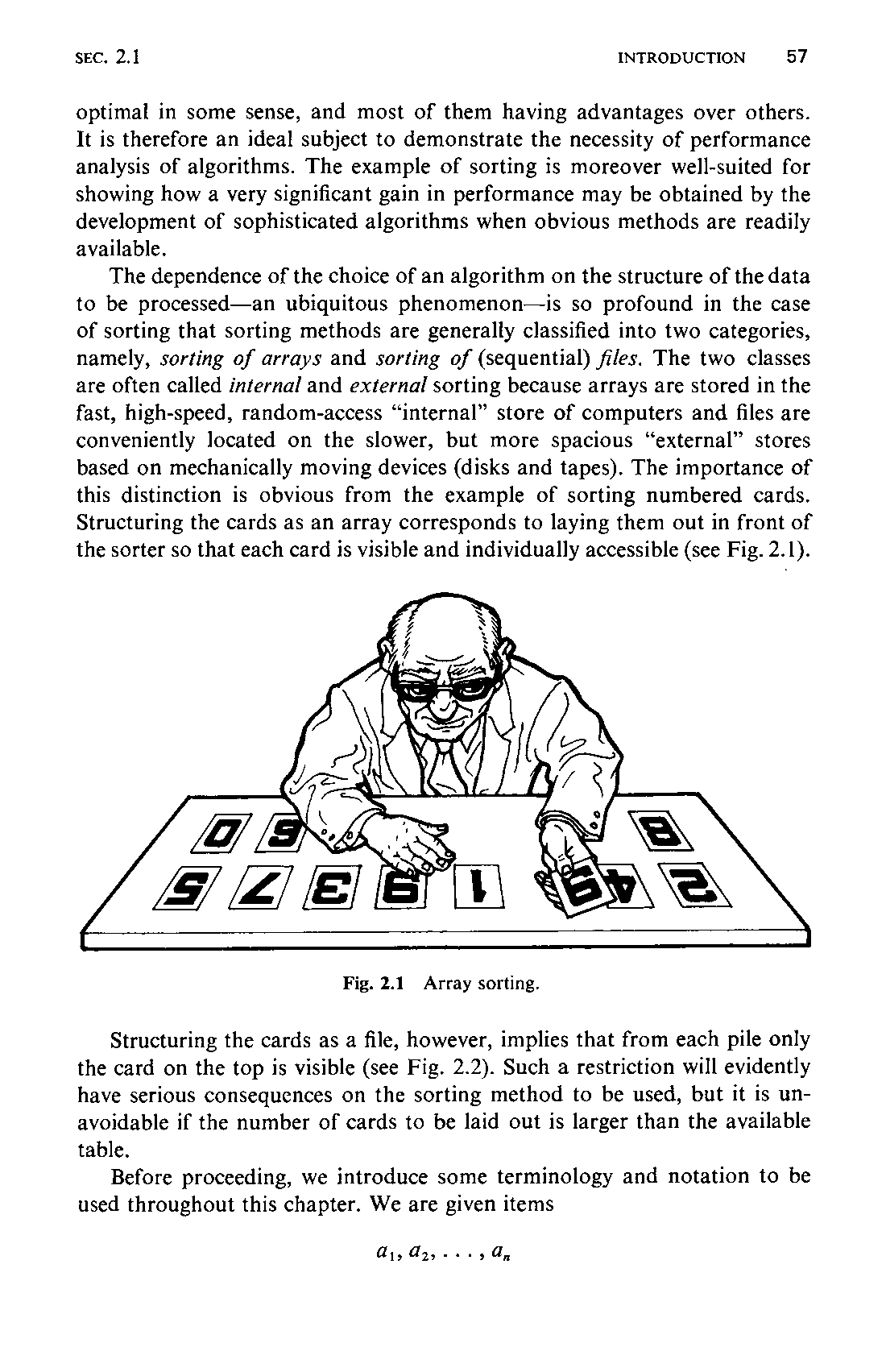
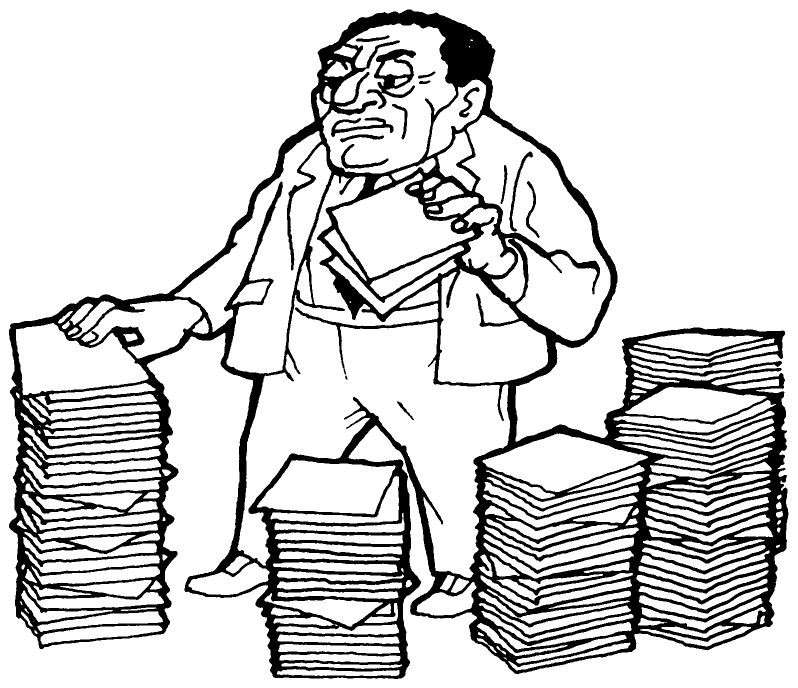
The dependence of the choice of an algorithm on the structure of the data to be processed—an ubiquitous phenomenon—is so profound in the case of sorting that sorting methods are generally classified into two categories, namely, sorting of arrays and sorting of (sequential) files. The two classes are often called internal and external sorting because arrays are stored in the fast, high-speed, random-access “internal” store of computers and files are conveniently located on the slower, but more spacious “external” stores based on mechanically moving devices (disks and tapes). The importance of this distinction is obvious from the example of sorting numbered cards. Structuring the cards as an array corresponds to laying them out in front of the sorter so that each card is visible and individually accessible (see Fig. 2.1).
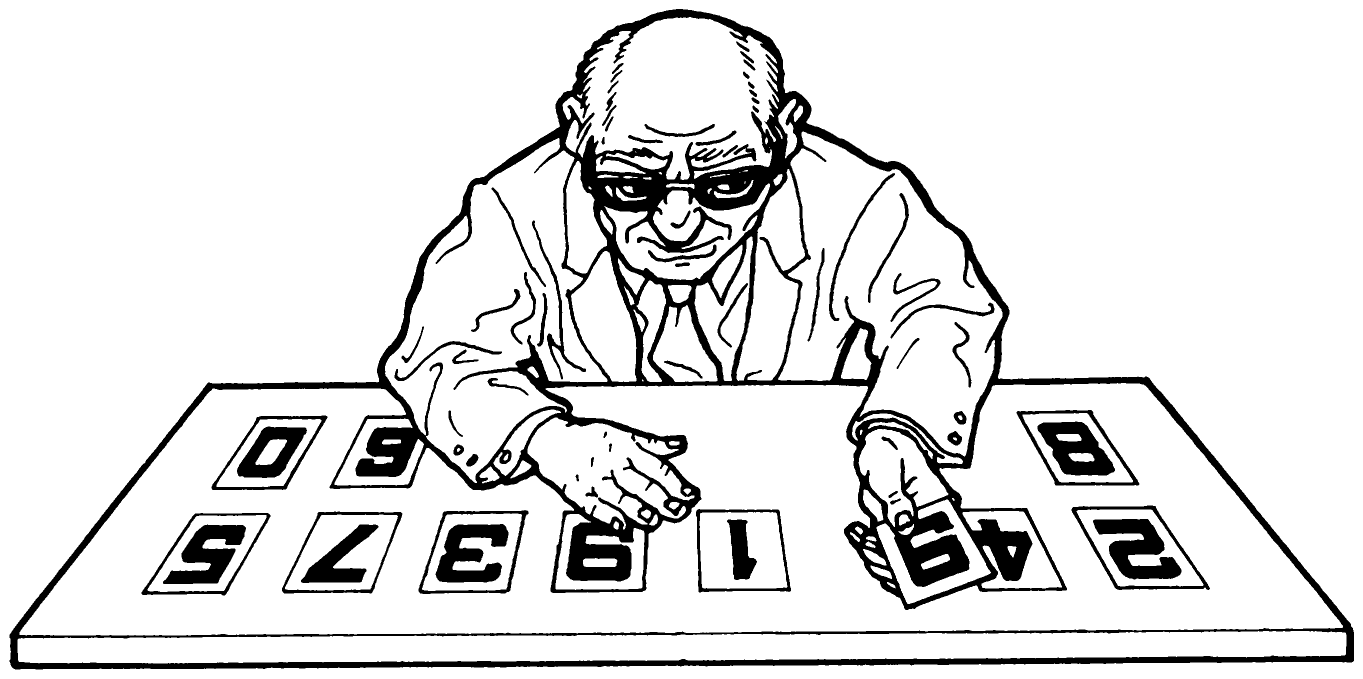
Structuring the cards as a file, however, implies that from each pile only the card on the top is visible (see Fig. 2.2). Such a restriction will evidently have serious consequences on the sorting method to be used, but it is unavoidable if the number of cards to be laid out is larger than the available table.
Before proceeding, we introduce some terminology and notation to be used throughout this chapter. We are given items
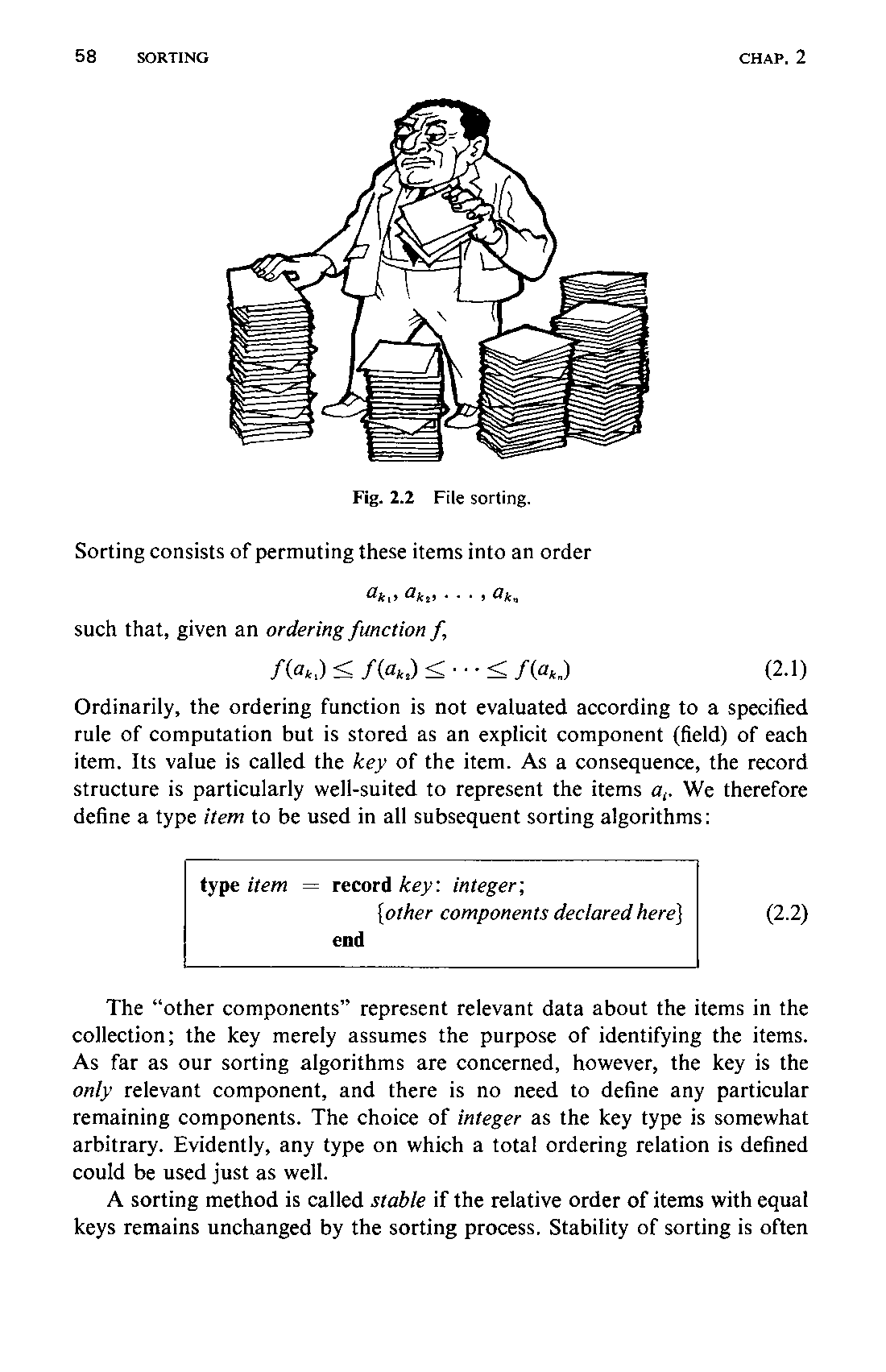
Sorting consists of permuting these items into an order
such that, given an ordering function ,
Ordinarily, the ordering function is not evaluated according to a specified rule of computation but is stored as an explicit component (field) of each item. Its value is called the key of the item. As a consequence, the record structure is particularly well-suited to represent the items . We therefore define a type item to be used in all subsequent sorting algorithms:
type item = record key: integer;
                 {other components declared here}
            end
(2.2)
The “other components” represent relevant data about the items in the collection; the key merely assumes the purpose of identifying the items. As far as our sorting algorithms are concerned, however, the key is the only relevant component, and there is no need to define any particular remaining components. The choice of integer as the key type is somewhat arbitrary. Evidently, any type on which a total ordering relation is defined could be used just as well.
A sorting method is called stable if the relative order of items with equal keys remains unchanged by the sorting process. Stability of sorting is often59 desirable if items are already ordered (sorted) according to some secondary keys, i.e., properties not reflected by the (primary) key itself.
This chapter is not to be regarded as a comprehensive survey in sorting techniques. Rather, some selected, specific methods are exemplified in greater detail. For a thorough treatment of sorting, the interested reader is referred to the excellent and comprehensive compendium by D. E. Knuth [2-7] (see also Lorin [2-10]).